|
|
|
|
|
Home : Maronite Saints |
Church of Jesus |
 | |
 | |
|
|
| |
| Saints of
The Catholic Maronite Church
|
|
1 |
Maronites and Lebanon, Sts
Maroun and John Marounn - En |
|
2 |
3 Saints from Lebanon, Sharbel & Rafca & Hardini
- En |
|
3 |
4 Saints of Church, Maroon & Charbel &
Rafca & Hardini - En |
|
4 |
3 Saints of Maronite Church - Charbel,
Rafca, Hardini - Fr |
|
5 |
Sts Sharbel & Rafa & Hardini’s Words - Ar
من أقوال القدسين الثلاثة
:
شربل ورفقا والحرديني |
|
6 |
6 Saints of
Church, Maroon & John Maroon & Marina ... - Ar |
|
7 |
La Maison Saint-Charbel Suresnes-France - Fr |
|
8 |
The Syrian Maronite Saints - Ar |
|
9 |
Saint Simon, 384 - 459 - Ar
|
|
10 |
The Three Massabki Brothers, the Martyrs - En |
|
11 |
Saint
Thekla, first century - En & Ar |
|
12 |
The
Sainthood - Brother Estephan Nehme - En & Ar |
|
13 |
The
Sainthood - Patriarch Estefan
Duwayhi - En, Fr & Ar |
|
14 |
The
Cross of Lebanon - Father Yaccoub - En, Fr & Ar
|
|
15 |
Father Antoine Tarabay - Ar |
|
16 |
Tne Blessed, Mother Marie Alfonsin - Ar |
|
17 |
Saint
Yacoub Hamatouri - Ar
|
|
18 |
List of associations in Lebanon |
|
19 |
Father Bchara Abou Mrad - Ar |
|
20 |
Father Youssef Abi Maroun Maatouk - Ar |
|
21 |
Patriarch Jebrael from Hejoula
or Cheikh Massoud
- Ar |
|
22 |
The Sainthood Fathers, Thomas Saleh &
Léonard Melki |
|
23 |
Father Egnatios
Tanouris - Ar |
|
24 |
Doctor Jamil ZGaib, Live testimony - Ar |
|
|
|
|
| |
 |
Les Saints de l'Eglise
Catholique Maronite |
|
|
1 |
Les Maronites et Le Liban,
Icônes, Sts Maroun et John
Maroon - En |
|
2 |
3 Saints
du Liban, Sharbel et Rafca et Hardini
- En |
|
3 |
4 Saints de l'Eglise, Maroon &
Charbel & Rafca & Hardini - En |
|
4 |
3 Saints
de l'eglise Maronite - Charbel,
Rafca, Hardini - Fr |
|
5 |
Paroles des Saints Sharbel
et Rafa et Hardini
- Ar
من أقوال القدسين الثلاثة
:
شربل ورفقا والحرديني |
|
6 |
6 Saints de l'Eglise, Maroon &
John Maroon & Marina ... -
Ar |
|
7 |
La Maison de Saint Charbel en
France - Fr |
|
8 |
quelque Saints de l'Eglise
Syrien Catholique Maronite- Ar |
|
9 |
Saint Simon, 384 - 459 - Ar
|
|
10 |
Les Trois Frères Massabki, les Martyrs
Maronites - En |
|
11 |
Saint Thekla , la premiére
Martyre - En et Ar |
|
12 |
Le Bienheureux, le Frère
Estephan Nehme - En et Ar |
|
13 |
Le Bienheureux, Le
Patriarche Estefan
Duwayhi - Fr, En et Ar |
|
14 |
Le Croix du Liban, le Pére
Yaccoub - Fr, En et Ar |
|
15 |
Le Pére Antoine Tarabay - Ar |
|
16 |
La Vénérable, La Mère
Marie Alfonsin - Ar |
|
17 |
Saint
Yacoub Hamatouri - Ar
|
|
18 |
Liste des associations au Liban |
|
19 |
Le Pére Bchara Abou Mrad - Ar |
|
20 |
Le Pére Youssef Abi Maroun Maatouk - Ar |
|
21 |
Patriarch Jebrael from Hejoula
ou Cheikh Massoud
- Ar |
|
22 |
Les Bienheureux Peres, Thomas Saleh &
Léonard Melki - Ar |
|
23 |
Le Pére Egnatios
Tanouris - Ar |
|
24 |
Docteur Jamil ZGaib, temoinage vive - Ar |
|
|
|
|
| |
|
|
قدسين من الكنسية
السريانية المارونية
الكاثوليكية |
|
|
|
|
|
| |
|
|
|
|
| |
|
|
|
Maronite Saints
'Enlarge' | |
| |
| |
|
|
|
|
| |
|
|
| |
 |
|
| |
| |
| Maronite history is coloured with the
romance that attaches itself to a struggle of a
determined people. Most nations in their history
often have to make a choice between
confrontation or cooperation and time has shown
us that minorities usually pay for their
continued existence through deformation of
character or out right collaboration.
| | |
|
| |
|
| |
Life of
saints Maroun and John Maroun
|
|
English
Texts -
135 KB zip
file
download |
 |
|
|
|
|
|
|
|
| |
|
| Continue |
|
Life
of Saint Maroun
- English Text |
| | | |
| |
The
Maronites through perpetual resistance and the
preservation of a precarious independence have
escaped this fate. Not only have they
survived, but they have survived uncowed.
The remarkable nature of their history lies hand
in hand with that of Lebanon, for centuries
being their retreat and fortress. Lebanon and
the Maronites are inseparably attached. The
Maronites have survived the storms of invasion,
occupation, repression and suppression for over
1600 years, preserving their religion,
traditions and state. Through the ages they
refused to bow to their occupiers, at the
height of the Umayyad dynasty the Maronites even
exacted tribute as a price for their good
behaviour, in due course their Christian
neighbours all succumbed to Islam but not
Lebanon, holding a Maronite majority well into
the 20th century, even their Syriac (Christian
Aramaic) language was widely spoken well into
the late 19th century and still survives today
in their liturgy and in some of their villages.
The mountain Maronites remain much as the
earliest travelers found them, not having lost
the virtues for which they have been admired.
The ingenuity and perseverance with which they
have tamed the hillsides is remarkable, striving
for soil, capturing it from rocks laboriously,
foot by foot. Their terraced vines, piled
vertically one above the other, climb to the
snows. Their minute orchards are often wedged in
the faults and crannies of precipices. Such
industry has its reward, the very rocks have
grown fertile. Their long political struggle and
the effort to squeeze a livelihood from the
rocks and precipices have made them independent,
courageous and provident.
| Life of Saint
Maroun |
| |
Saint Maroun, born
in the middle of the 4th century was a priest
who latter became a hermit, retiring to a
mountain of Taurus near Antioch. His holiness
and miracles attracted many followers, and drew
attention throughout the empire. St John of
Chrysostom sent him a letter around 405 AD
expressing his great love and respect asking St
Maroun to pray for him.
St Maroun's way was deeply monastic with
emphasis on the spiritual and ascetic aspects of
living. For Saint Maroun, all was connected to
God and God was connected to all. He did not
separate the physical and spiritual world and
actually used the physical world to deepen his
faith and spiritual experience with God.
St
Maroun embraced the quiet solitude of the
mountain life. He lived his life in open air
exposed to the forces of nature such as sun,
rain, hail and snow. His extraordinary desire to
come to know Gods presence in all things,
allowed St Maroun to transcend such forces and
discover that intimate union with God. He was
able to free himself from the physical world by
his passion and fervour for prayer and enter
into a mystical relationship of love with God.
This missionary work came to fruition
when in the mountains of Syria, St Maroun was
able to convert a pagan temple into a Christian
Church. This was to be the beginning of the
conversion of Paganism to Christianity in Syria
which would then influence and spread to
Lebanon. After his death in the year 410 AD, his
spirit and teachings lived on through his
disciples.
Link
: http://www.maroun.org/
| | |
|
|
|
|
|
|
| | |
|
| |
|
|
| |
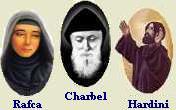
They
are sanctified at Saint Peter Basilica in
Rome.
- Saint
Charbel, 7 -
October 1977
- Saint
Rafca,
10 - June
2001
- Saint Hardini,
16 - May
2004
|
 | |
|
Continue |
Life of
Saints,
Charbel, Rafca & Hardini
- English
Text |
| |
| |
|
Life of Saint
Charbel
|
 |
|
Born at
Beqaa-Kafra, the highest inhabited place in
Lebanon, near the famous cedars, the young
Joseph Makhlouf grew up with the example of two
of his uncles, who were both hermits, before his eyes.Aged twenty-three, he left home secretly
and entered the monastery of Our Lady of Mayfuq,
taking the name of a Syrian martyr, Charbel, on
his admission. Ordained a priest in 1859, he
took up his residence at the monastery of St
Maroun at Annaya, which is over 3500 feet above
the Mediterranean Sea.
Father Charbel lived
in this community for fifteen years, and was a
model monk in the exact sense of the word: it is
recorded that, although he rejoiced to be able
to be of the slightest assistance to his
neighbour, nevertheless it was always a trial to
him to leave his monastery. It was his delight
to pass his time in singing the office in choir,
in working in the fields and in spiritual
reading, and nobody was surprised when
eventually he asked, and received permission to
go and live the life of a hermit. Whilst
Maronite monks are generally engaged in
parochial and pastoral work, provision is
nevertheless made for those chosen souls who
feel called to the eremitical life to pursue
their vocation, generally in groups of two or
three.
So began for the new hermit that holy
life which has been led unaltered since the days
of the desert fathers: Perpetual fasting, with
abstinence from meat, fruit and wine; manual
work sanctified by prayer; a mattress stuffed
with leaves and covered with goatskin for a bed
and a block of wood wrapped in a piece of old
habit for a pillow; the interdiction to leave
the hermitage without express permission. St
Charbel placed himself under obedience to the
other hermit, and passed twenty-three years
thus, his various austerities seeming only to
increase the robustness of his health. The only
disturbance to his prayer came in the form of an
ever-increasing stream of visitors drawn by his
reputation for sanctity to seek from him advice,
the promise of prayer or some miracle.
Then
one morning, in the middle of December 1898, he
was taken ill without warning, just before the
consecration while celebrating Mass. His
companion helped him to his cell, which he was
never to leave. The paralysis gradually gained
on him and he was anointed. On the night of
Christmas Eve he died, repeating the prayer
which he had been unable to finish at the altar:
"Father of truth, behold Thy Son, who makes
atoning sacrifice unto Thee. Accept the
offering; He died for me that I might have life.
Behold the offering! Accept it..." The words
summed up a life of seventy
years.
Link
: http://www.charbel.org/
|
| Life of Saint
Rafca |
|
من
اقوالها: " أنا أتحمل مرضي بصبر لأنه لخلاص نفسي" |
|
 | |
She was born in
Himlaya, a small village near Bickfaya (Metn),
on June 29, 1832 and was given the name
Petronilla as a reminder that she was a daughter
of St. Peter, on whose feast day she entered the
world.
The Land of Rafca is Lebanon: a
country, torn by four years of war, in search of
peace and tranquillity. The wealthy, big powers
have brought their conflicts there and are
trying to resolve them there. The greatness of
that Land lies in the fact that it has always
been a land of refuge.
The Land of Rafca is
the land of the Canaanites and the Phoenicians,
and is mentioned with enthusiasm and wonder more
than sixty times in Holy Scripture.
Like
Therese of Lisieux, Rafca, "The Little Flower of
Lebanon," the "Purple Rose," the "Silent and
Humble Nun", had to tell her life story to her
Mother Superior some months before her death.
Obedience to this request is the reason why
today we are able to know something about this
woman who sought for nothing else but to be
forgotten by men and live only for God. However,
the perfume of this violet immediately spread
after her death and has attracted the attention
of the ecclesiastical authorities.
The Cause
for Beatification of the Servant of God, Rafca,
is currently in Rome. It will now be up to the
Holy Father to make the final decision regarding
her virtues and the graces obtained through her
intercession, as to whether he will elevate her
to the ranks of the saints. As we anticipate and
pray for this glorious day, we submit ourselves
to the decision of the Church and patiently
wait.
Rafca's condition grew more
serious. The pain she was enduring in her eyes
became excruciating. Her Superior sent her to
Tripoli for treatment. The treatments were most
painful, too, and she lost a great deal of
blood. However, during all of this time, she
kept repeating, "With your sufferings, O Lord,
for your glory." ...
In 1897, a group of
nuns from the convent of St. Simeon of the Horn
moved to the new convent of St. Joseph Ad-Daher.
Mother Ursula, who was to be the Superior of the
new foundation, asked to have Sister Rafca
included in the group. She wished to have her
example before the eyes of the sisters as they
met with the hardships that are always inherent
in establishing a new foundation.
Sister
Rafca spent the last seventeen years of her life
in this convent which was to be the scene of her
greatest sufferings, as well as of her greatest
spiritual joys.
Rafca was not to disappoint
Mother Ursula. Her example and assistance proved
invaluable in establishing the new convent. The
novices especially were impressed with the blind
nun's spirit of prayer, humility, and charity.
Many years later, after her death, several of
Rafca's sisters who had either come with her to
the new foundation, or who had been novices
during the seventeen years that she lived at St.
Joseph Ad-Daher and had never forgotten what
they had observed of their sister's life,
testified regarding her holiness...
...Rafca
suffered for seventeen years as a blind
paralytic. Only God knew how much she had to
endure. Her pain was continuous night and day,
yet the other sisters never heard her murmuring
or complaining. She often told them that she
thanked God for her sufferings, "...because I
know that the sickness I have is for the good of
my soul and His glory" and that "the sickness
accepted with patience and thanksgiving purifies
the soul as the fire purifies gold."
She was
always quiet and calm, smiling, enduring even
the greatest pain with patience, hoping in the
Lord who promised to increase the glory of His
faithful servants in heaven (Lk. 21:19).
By
her patience, she can be compared to the
greatest of the saints.
A few years
before she died, Rafca's Bridegroom granted her
two more favors to show His acceptance of her
offering of herself as a Victim of Love.
One
day, mother Ursula noticed that Rafca seemed to
be suffering much more than usual and, touched
by pity for the poor sister, asked her, Is there
anything else you want from this world? Have you
never regretted the loss of your sight? Don't
you sometimes wish you could see this new
convent with all the natural beauties that
surround it--the mountains and rocks, and the
forests?"
Sister Rafca answered simply, "I
would like to see just for an hour, Mother--just
to be able to see you."
"Only for one hour?"
asked the Superior. "And you would be content to
return to that world of darkness?"
"Yes,"
replied the invalid.
Mother Ursula shook her
head in wonder and began to leave Rafca's cell.
Suddenly, the paralyzed nun's face broke into a
beautiful smile and she turned her head toward
the door. "Mother," she called, I can see you!"
The Superior turned around quickly and saw
the glow on Rafca's face. That alone was enough
to tell her that her daughter was not teasing,
but she wanted to be certain that the phenomenon
was actual and not just a trick of the mind of
the poor nun who had been blind for so many
years.
Desperately trying to conceal her
emotions, she walked back to the bedside.
"If it is as you say," she queried, "tell me
what is lying on the wardrobe." Sister Rafca
turned her face toward the little closet and
answered, "The Bible and the Lives of the
Saints--she could hardly contain her excitement.
But, she reasoned, perhaps Rafca knew that these
were the only two books in her cell as she had
no need for others and the sisters who read to
her usually only used these two titles--knowing
that the invalid loved them best.
Another
test would have to be tried and this time,
witnesses were called in the testify to the
miracle.
There was a lovely multi-colored
cover on Rafca's bed. Mother Ursula called her
attention to it and began to point to the colors
one by one, asking the newly-sighted nun to call
out the names of the colors as she pointed to
them. The three sisters who assisted the
Superior in the test verified that Sister Rafca
named each color correctly.
As she had
requested, though, this new sight lasted only
for one hour during which time she conversed
with Mother Ursula and looked around her cell,
at her siters, and through the window to catch
glimpses of the beauties outside.
After this
time, she fell into a peaceful sleep. The Mother
Superior remained at Rafca's side for a short
time and then decided to waken the nun to see if
she would be able to see again...
Link
: http://www.rafca.org/
|
| Life of Saint
Hardini |
|
من اقواله:
"
الشاطر اللي بيخلِّص نفسو!
" |
|
 | |
Father Hardini was
born Joseph Kassab in the year 1808. His father
was George Kassab and his mother Marium Raad,
daughter of Reverend Yousef Yacoub. He had four
brothers and two sisters, his brothers were
'Assaf, Elias, Tanious, Yacoub and his sisters
Masihieh and Mariam. Joseph's brother Elias
became Father Lesha', the Hermit at Qozhaya, and
later at 'Annaya where he died. Father Charbel
replaced the late Father Lesha' at the hermitage
in 'Annaya. Joseph entered the school of the
monks of St. Anthony at Houb from 1816 to 1822
and then entered the monastery of St. Anthony
Ishaia and became a novice on November 1828.
There he adopted the name Fr. Nimatullah Kassab
Hardini, then he learned to bind books.
He
professed his first vows on 14th of November
1830. After he finished his theological studies,
he was ordained a priest under Bishop Seiman
Zwain in the monastery of Saints Qobrianos and
Youstina, in Kfifane (Batroun, North Lebanon) on 25th of
December 1833.
He became a member of the
general council three times from 1845 to 1848,
1850 to 1853, 1856 to 1858. As a member of the
council he continued to bind books. He taught in
monastic schools, especially in Kfifan.
Father Nimatullah lived a very holy life. He
was a man of prayer, totally "enraptured by
God". He spent days and nights in meditation,
prayer and adoration of the Eucharist. The
Virgin Mary was his patron and Father Nimatullah
prayed Her Rosary. He was also a very humble,
sensitive and patient person who lived his
monastic vows of "obedience, chastity and
poverty" to perfection. His fellow brother Monks
and the people who knew him called him "The
Saint" while he was still alive. One of his
students was Charbel Makhlouf (St. Charbel),
1853 to 1858.
Father Nimatullah Hardini died
in the monastery of Saints Qobrianos and
Youstina, in Kfifane on 14th December
1858. He passed away after struggling ten days
with a high fever which he contracted from the
cold winter wind characteristic of northern
Lebanon. He was only then fifty years of age. He
died holding a picture of the Virgin Mary, his
last words being: "O Virgin Mary between your
hands I submit my soul." People who were nearby
at the moment of Father Nimatullah's death
witnessed a heavenly light illuminating his room
and an aromatic smell which remained in his room
for a number of days afterwards. When the then
Patriarch, Boulos Massad, heard of Father
Nimatullah's death he commented:
"Congratulations to this monk who knew how to
benefit from his monastic life."
Some time
later, the Monks opened Father Nimatullah's tomb
and to their surprise they found his body had
remained incorrupt. He was then removed and
placed in a coffin near the church. After
obtaining due permission from the local
ecclesiastical authority, from 1864 visitors
were allowed to see Father Neemtallah's intact
body until 1927. In that same year the Committee
of Inquiry set up to investigate the Cause of
Father Nimatullah finalised its investigation.
Father Nimatullah's body was then reburied in
the curving wall of his monastic cell, before
being transferred to a little Chapel where
masses are celebrated for visitors.
He was
declared Venerable on September 7, 1989. At the
behest of his Beatitude Patriarch Nasrallah
Peter Sfeir, his body was examined and placed in
a new coffin on May 18, 1996. His body was
recently transferred to a new coffin made of
cedar and placed in the Monastery of
Saints Qobrianos and Youstina, in Kfifane
where people may visit.
Several cures have
taken place through his intercession. These
include the raising to life of a Muslim child
whose mother claimed had died, the healing of a
person with a neurological disease, the
restoration of sight to a blind person and the
curing of a person suffering from cancer.
The case of the curing of Andre Najm is of
particular note due to its very recent occurance
and thourough investigation by the international
medical community that followed. Andre Najm,
born on October 29, 1966 enjoyed excellent
health for the first twenty years of his life.
However in June of 1986 he began to experience a
chronic fatigue and nervous breakdowns, unable
to even walk a short distance. Many physicians
in Lebanon and abroad treated him to no avail.
He was suffering from a form of blood cancer and
required frequent blood transfusions.
In May 10, 1998, Pope John
Paul II, presided the great celebrations of his
beatification. (and then of his canonization a
Saint for the Universal Catholic Church, in May
16th, 2004-this last line in italic I added).
May his prayers be with us always. Amen.
Link
: http://www.hardini.org/
| | |
|
| |
| |
|
كلمات للقديسة رفقا -
Words of Saint Rafca |
Ar text - 282 KB pdf file
download |
Ar text - 82.7 KB zip file
download |
|
| |
| | |
|
|
- 4
saints of Church - Maroun, Charbel, Rafca
and Hardini
- Icons, Biographies &
Prayers
- English texts, HTML files
|
|
|
| |
|
| |
|
|
| |
|
3 Saints Libanais de
l 'eglise
- Charbel,
Rafca et Hardini , en Francais
|
|
- Charbel
Makhlouf
1828 - 1898
- Rafka el-Rayès
1832 - 1914
- Nimatullah
Kassab
Hardini
1808
-
1858
|
 | |
Icons, Biographies, Miracles
et Priéres
Textes en Francais - ( French
Language), HTML
Files |
| |
|
|
|
Continue |
Paroles des Saints Sharbel et Rafa
et Hardini |
|
|
| |
|
من كلمات
القديس شربل
من احدى رسائله
الى السيد ريمون ناضر سنة 1994:
"التزموا
إلتزام كامل بالكنيسة وبكلّ تعاليمها، وثابروا على الصلا بدون ملل.
كرّموا أمّنا مريم العدرا، وتسلّحوا بالمسبحة، لأنّو إسم مريم العدرا
بيبدّد الظلمة وبيسحق الشرّ. كونوا رهبان بقلب هالعالم، ولو بدون
ثوب. إزرعوا الأرض صلا وبخور. كونوا قدّيسين وقدّسوا الأرض. درب
القداسة طويل، لكن تأكّدوا إنّو لمّا بتكون أفكار الله بعقولكن،
ومحبّة الله بقلوبكن، بتكون قوّة الله بزنودكن وبتوصلوا. وتأكّدوا
إنّو كلّ ما تكونوا عم تصلّوا، بكون عم بصلّي معكن، تا تتقدّسوا
ويتمجّد إسم الربّ" |
| |
من
اقوال القديسة رفقا: " أنا أتحمل مرضي بصبر لأنه لخلاص نفسي"
" كانت تقول للراهبات معها
في الدير ما تكتفوا تقدسوا عبكرا وتتناولوا وتزوروا
القربان مرة او
مرتين بالنهار وخلصنا. إذا فيكن الف مرة بالشوق
تتناولوا روحيا،
فالقربان فعل محبة، وكأنك انت وعم تبلع بريقك عم
تتناول القربانة من ايد الكاهن، ما تتأخروا ولو
الف مرة بالنهار" |
|
|
|
من
اقوال القديس الحرديني:
"
الشاطر اللي بيخلِّص نفسو!
" |
|
|
|
| |
|
|
|
|
|
| |
| |
|
|
|
|
| |
|
قدسيون من الكنيسة
- حياتهم | | |
- Saint
Maroun
- Saint
Jean-Maroun
- saint
Marina
- Saint
Charbel
- Saint
Rafca
- Saint
Hardini
|
 |
| |
Icons, Biographies &
Prayers
Arabic texts, HTML
files |
| |
| |
|
|
-
L'historique de la maisom
-
Ecole pour enseigner l'arabe et le
catéchisme
-
Espace
Jeunesse
-
Ordre
Libanais Maronite ...
- Information, pictures , French Texts,
HTML Files
|
|
|
| |
|
|
|
الكنيسة السريانيّة المارونيّة الأنطاكيّة،
ابنة مارون
- سيرتهم |
-
Maronite monks
Martyrs
-
Maronite saints; Ibraham and
Yaccoub
-
Icons and
Biographies
-
English texts,
HTML files
|
|
|
 |
|
| |
|
|
|
القديس سمعان
العامودي
459-384
- حياته |
-
Maronite monks
Martyrs
-
Maronite saints; Ibraham and
Yaccoub
-
Icons and Biographies
-
English texts, HTML files
|
-
أصله،دعوته،
تنسكه
على العامود وصيامه
-
معجزات
ونبوات سمعان
-
سمعان يحكم بالعدل ويتدخل
في حياة الكنائس
-
الرهبنة العمودية وانتشارها
-
نبذة
تاريخية لقلعة
او
كنيسة القديس سمعان
|
|
 |
|
|
|
|
|
- The
Three Massabki Brothers, Martyrs at Damascus,
at the end
of the XIII century
-
their names -
Francis, Abdel Mohti and
Raphael children of Ne’meh Massabki
-
Biography, information and Icons
-
English text, HTML file
|
 |
|
|
|
|
|
|
- Life
of the Sainthood
- Information and Pictures from church
St Takla - Sed El Baouchrie,
Lebanon
- 2
types of Texts - Arabic and English, Html
files
|
| |
| Arabic Texts - 520 KB
zip file download |
| English Tests - 367
KB zip file download | | |
- Biography
Also
Thekla was, according to ancient
tradition, a convert and companion of Paul, whom
Paul commissioned to teach and to baptize.
|
 | |
|
|
Continue |
Life of Saint Thekla - first
century |
|
|
|
| |
It was at
Iconium that Saint Thekla heard the preaching of
Saint Paul, who kindled the love of virginity in
her heart. She had been promised in marriage to
a young man who was rich and generous, but after
hearing the discourses of the Apostle’s word she
died to all thought of earthly espousals. She
forgot her beauty; she was deaf to her parent’s
threats, and at the first opportunity fled from
a luxurious home and followed the
Apostle.
The rage of
her parents and of her suitor followed hard
after her, and the Roman power did its worst
against the virgin whom Christ had chosen for
Himself. She was stripped and placed in the
public theater, but her innocence shrouded her
like a garment. Then the lions were let loose
against her; they fell crouching at her feet and
licked them like a house pet. Even fire could
not harm her.
She preached the Gospel and
converted many to the faith before withdrawing
to a solitary place to lead a life of
asceticism. She lived as a hermitess there for
the next seventy-two years and died there.
Her monastic foundation is
near Maaloula, Syria. |
| | |
| |
|
|
- Brother
Estephan Nehme
- Life
of this Sainthood
- Information and Pictures
- Html
files, Arabic Text
|
|
Arabic Texts - 138 KB zip file download |
حياته هي
الاعجــوبة الكبرى
تحوله من انسان فلاح
الى
طوباوي على طريق
القداسة
من أقواله
: "
الرب
يراني "
|
|
|
- Biography
Brother
Estephan Nehme, a Maronite monk,
is on the way to Sainthood.
Rome, on December 17, 2007, honored in
the Catholic Church
He was born in Lehfed in 1889. He entered
religious life in 1905. He professed his
vows in 1907
He was known for his
creativity, silence, prayer, exercising divine
& human virtues
He died in the
monastery of Saints Qobrianos and Youstina,
in Kfifanee in 1938
|
|
 | | |
|
Continue |
The Monastery of Saints
Qobrianos and Youstina, in Kfifane - Lebanon |
|
|
|
| |
 English
- The Monastery of Saints
Qobrianos and Youstina, in Kfifane -
Lebanon English
- The Monastery of Saints
Qobrianos and Youstina, in Kfifane -
Lebanon |
| |
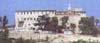
| The old building of the monastery
had existed even before the seventh century A.D.
and there is a dating of the monastery as early
as 717 A.D. It was named after the Two martyrs
Cypian and Justine when it was converted in 1230
into a patriarchal see in the days of Maronite
Patriarch Daniel of Shamat.
In 1766 the Lebanese Maronite Order
received the monastery, whose first superior was
appointed in 1775. |
 | |
| The monastery became a major
seminary for teaching philosophy, theology,
literature and law. among its graduates were a
large number of priests, including Father
Nimatullah Kassab al-Hardiny or al-Hardeeny
(Saint Nimatullah), Father Charbel Makhlouf
(Saint Charbel), Father Emmanuel Gemayel and
Father Nimatullah al-Kafry... Studying was
resumed in it in 1891.
In 1897, superiors added another
boarding school.
In 1899, the novitiate was erected
in the monastery and lasted until 1950. Then it
was erected again in 1977 and has remained there
ever since.
The monastery currently contains
the tombs of Saint Nimatullah Kassab al-Hardini
and Righteous Brother Estephan
Nehmeh. | |
| |
|
| |
French -
NOTICE HISTORIQUE SUR LE MONASTERE
SAINTS CYPRIEN ET JUSTINE,
KFIFANE |
| |
| L’histoire de ce monastère
remonte, en ce qui concerne son ancien bâtiment,
à une époque antérieure au VIIe siècle ap. J.-C.
Il est mentionné dans une note historique de
l’année 717. Il a été dédie aux deux martyrs
Cyprien et Justine, lorsqu’il a été transformé
en siège patriarcal du temps du patriarche
maronite Daniel de Chamat, en 1230. L’Ordre Libanais Maronite l’a reçu
en 1766. Son premier supérieur fut désigné en
1775.
Il a été désigne comme séminaire
monastique supérieur pour l’enseignement de la
philosophie, de la théologie, des lettres et du
droit, de 1808 a 1874. De nombreux prêtres ont
été parmi ses anciens. Parmi les plus
célèbres : Le père Nimatullah Kassab
al-Hardini, le père Charbel Makhlouf ( Saint
Charbel), le père Emmanuel Gemayel et le père
Nimatullah al-Kafri… On y reprit l’enseignement
en 1891.
En 1897, les Supérieurs ont
associé à ce séminaire, un autre à régime
d’étudiants internes et
externes.
En 1899, le monastère de Kfifane
est transformé en un monastère pour le noviciat,
jusqu'à l’année 1950.
Il a été de nouveau désigné comme
centre de noviciat, en 1977 et jusqu'à nos
jours.
Ce monastère renferme
actuellement la tombe du Bienheureux P.
Nimatullah Kassab al-Hardini et la dépouille du
juste, Frère Estephan Nehmé. | | | |
| |
| |
|
|
| He was
known as “The Saint Patriarch,” “The Saint of
the Patriarchs,” “The Father of Maronite
History,” “Pillar of the Maronite Church,” “The
Second Chrysostom,” “Splendor of the Maronite
Nation,” “The Glory of Lebanon and the
Maronites.” |
 | |
- Life and
Times of the Sainthood ...
- Detail
Information and Pictures
- Arabic,
French and English
Texts, Html
files
|
| English Texts - 85 KB
zip file download |
| French Texts - 94 KB
zip file download |
| Arabic Texts - 138 KB
zip file download | | | |
|
Continue |
Life of The Sainthood -
Patriarch Estefan
Duwayhi |
|
|
Early
life
El
Douaihy was born at a time when the Maronites
were suffering badly from Ottoman oppression.
However, the Ottoman empire was not benefiting
from the expansion of world commerce, and so the
Ottoman rulers, and the local Muslim and Druze
chiefs who ruled with Ottoman consent (something
which could be withdrawn) enriched themselves by
taxing the Maronite peasantry. At the age of
sixteen, recognized as a brilliant young talent,
he was sent to the Maronite College (Seminary)
in Rome. [4]
He studied there for nine years, being cured of
a serious condition which almost led to
blindness. El Douaihy believed that the
intercession of the Blessed Virgin Mary was
responsible for his cure. While in Italy, he
traveled as widely as possible seeking
manuscripts dealing with Maronite history and
liturgy. When he returned to Lebanon at the age
of 25, he continued his research.
Expanded
description
As
bishop, and later as Patriarch, he undertook
reforms of the Maronite Church and its monks.
Douaihy was elected Patriarch in 1670, when he
was only 40 years old. This is universally seen
as an acknowledgment of his personal moral
qualities, his extraordinary learning, and his
keen appreciation of the issues the Maronites
faced. He paid particular attention to the
traditions of the Maronite Church, and favoured
a de-Latinisation of rites and ceremonies. He
was hounded - there is no better word - by
Ottoman authorities, who resented his principled
appeals for justice for the Maronites. In
particular, they were frustrated by his
resistance to their oppressive taxation
policies: policies which saw the abandonment of
many villages by peasants unable to pay their
taxes. It was also a period when Maronites and,
in particular, their clergy, were liable to
sudden arrest, assault and murder. The Patriarch
was not exempt, being assaulted himself. He was
accordingly obliged to move from place to place.
Yet, he maintained his writing, and without him,
we would be very much poorer in our knowledge of
Maronite matters.
Douaihy
traveled throughout the Maronite world,
including Cyprus and Aleppo, which were even
more important centers of the Maronite faith
then, although they are still important now.
This is partly because Aleppo was at that time a
focus for the international overland trade, the
only trade where the Ottoman empire had any
opening, given the European domination of the
sea routes.
Death and
afterward
Almost
immediately after his death, he was considered
by many Maronites of Lebanon, but particularly
in North Lebanon and in Zgharta, Ehden to have
been a saint. The Congregation of the Causes of
Saints issued the decree of nulla osta for his
beatification cause on December 5, 1996. The
Patriarchate of Antioch of the Maronites
proceeded with the diocesan investigation and,
at its culmination, submitted the results to
congregation, which validated the proceedings
with a decree dated on November 8, 2002. The
Positio for the beatification cause was
published in 2005 and it received the approval
of the Historical Commission of the Congregation
of the Causes of Saints on January 24, 2006. On
July 3, 2008, His Holiness Pope Benedict XVI
authorised the Congregation for the Causes of
Saints to draw up a decree on the heroic virtues
of Patriarch El Douaihy who will be referred to
as Venerable from the moment of publication of
the decree. Some of the miracles attributed to
him have been collected by M.S. El Douaihy.[5]
Religious, philosophical
and/or political views
Douaihy
strongly believed in the social importance of
education and science (being an amateur
scientist himself). Given the importance of
learning, and his experience in how far European
education exceeded Oriental, he pursued a
successful policy of sending as many Maronites
to Rome as possible, to become capable of
returning to the villages in which the Maronite
peasantry lived, and raising the level of
general education. Douaihy established a college
in Aleppo, which became the base for the
development of renewed monastic orders. As with
his educational policy, his monastic renewal was
a success, and still bears fruit
today.
Some of
Douaihy's historical theories (e.g. of the
perpetual orthodoxy of the Maronites) is
controversial. But as a whole, with one or two
exceptions, his general account of Maronite
history is accepted as trustworthy. It is
certainly the most satisfying general account of
Maronite realities into the eighteenth
century.
Works
Of
the many works of Patriarch El Douaihy, the vast
bulk are still available only in Arabic. A
selection has been translated into French by
Youakim Moubarac in Pentalogie
antiochenne/domaine Maronite[6].
That selection focusses upon his discussion of
the rites and cermonies of the Maronite Church.
However, his major work is a general history
book, Tarikh Al Azminah, available in
several
versions.
|
|
|
|
|
|
| The Cross of Lebanon
- The Venerable Father Yacoub
El-Haddad
,
1875 - 1954 |
|
حياة الاب يعقوب
الحداد الكبوشي، طوباوي الكنيسة المارونية، صليب
لبنان |
- The Father
Yaccoub El-Haddad, a Lebanese Capuchin, the
"St. Vincent" of Lebanon, was known as and
popularly called "Aboona Yacoub"
- Father Yacoub.
- "L'Apotre de la Croix, le Vénérable Pére Jacques,
Capucin "
|
 |
|
- "Qui
veut être un saint, doit chasser de son cœur
tout ce qui n'est pas Dieu",
Abouna Yacoub
- "Si
tu as travaillé pour le ciel et tu as mis ta
confiance en Dieu , tout ce qui reste te sera
accordé", Abouna
Yacoub
|
|
Archive:
7 international
articles wrote about Abouna
- in Arabic, French or english |
|
Muli
languages
- 515 KB zip file download | | |
| |
Biographies ...
- Life
of the Cross of Lebanon. Abouna
Yaccoub
- Large
Information about Abouna Yaccoub and
the Congregation of the
Lebanese Framciscan Sisters of the Cross with
Pictures
- Arabic,
French and English
Texts, Html
files
|
|
|
English Texts - 1.18
MB zip file download |
|
French Texs - 884 KB zip file download |
|
Arabic Texts - 1.34 MB zip file download | | | |
|
Continue |
"O Croix du Seigneur, O
Bien Aimée
du Coeur " - Father Yaccoub
El-Haddad | |
Father Yaccoub was
born in Ghazir, son of Boutros and Shams Haddad,
in February 1st, 1875, the third of five
brothers, receiving the baptismal name of
Khalil, Studied in Mzar (st louis) school Ghazir
and then in Hekmeh beirut. In August of
1893 he was accepted in the Order of the
Franciscan Capuchin Friars. He was ordained a
Priest in November of 1901. In 1930 he founded the
Lebanese Cross Nuns. He established also
hospitals and schools leading the road to
saintety, in the poverty and obediance in the
service of the Lord. Died in June
1954.
“Following in the footprints of
Saint Francis of Assisi, Father Yaccoub lived
his holiness heroically, practicing all the
dimensions of charity in the face of all the
physical and moral miseries, giving all his
time, energy, talent, and pastoral dynamism,
even at the expense of his health, in order to
care for, heal, feed, and "to put bodies and
souls back on their feet again." In order to
continue his work, he founded the Congregation
of the Franciscans of the Cross of Lebanon.”
(Father Mansour Labaky).
| |
| |
Prayer to father
Yaccoub El-Haddad |
|
 |
| |
| 1 February 1875
- 26 August
1954 |
| |
 |
 |
 |
 |
 |
 |
 |
| |
من أقواله
في الصليب المقدَّس
- لا سماءَ إلاّ بالصليب.
- روحي وقلبي في الصليب!
- صليبُنا انتصَرْ إفرحوا يا شعوبْ؛
- قد علّمَ المصلوب سعادةَ البشر لا فخرَ
إلاّ بالصليب، ينبوعِ نعمتِنا العجيبْ.
- فرّحتَ قلبي يا أيّها الصليب، صليبَ
ربّي ومُنقِذي العجيب.
- كلّنا للصليب للعُلى للسما، كلّنا
للحبيبْ لأمّه مريما.
- إنَّ أكبرَ صليب هو الخوف من الصليب.
- يا صليبَ الربّ، يا حبيبَ القلب!
|
|
|
| |
| |
| The
Franciscan Sisters of the Cross of
Lebanon |
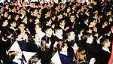
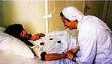
The
Franciscan Sisters of the Cross of Lebanon were
founded in 1930. In 1932 Sister Maria Zougheib
became the first Mother General. They became
Sisters of Pontifical Right in 1976 and their
Constitutions were definitively confirmed in
1983. Their apostolic works include hospital
assistance for Priests who are impeded from
continuing their ministry for reasons of health
or age. They also care for the disabled, blind,
crippled, mentally handicapped, the old, and
people abandoned by their families. The care for
and the education of the orphans occurs in
places where there are no other educational
facilities.
Link
: http://www.congfcl.org/ |
 | |
A brief
history of their foundations
includes:
- In 1957:
a school in Hrajel, 200 meters high, with an
objective of consolidating the presence of
families in their villages.
- In 1976:
in Rome they opened a Convent and a welcoming
house.
- In 1977:
they founded an institution for disabled girls
from Ijdabra.
- In 1977:
they settled in Bscele, in a house that was
given to them by the parents of a Religious
Sister, where today they have an
apostolate.
- In 1989:
foundation for old people at Shlifa, in the
Muslim and Christian region of Baalbeck
In
1992: foundation for the disabled and a mission
to sustain their families at Halba.
- In 1995:
a house for the mission at Bteddine El-Lekch. In
1995: a house for old people, constructed and
offered by a Jordanian Priest, Fr. Youssef
Naamat, from Eheiss in Jordan.
- In 1999:
a house for missions, offered by Bishop Philippe
Noujeim from Kfertay in Lebanon.
- In 2003:
Saint Francis High School in Ghazir, close to
the birth house of Father Giacomo, that the
Congregation has recently renovated.
|
 |
Also the Sisters
do secretarial and management services in other
places:
- The Apostolic Nunciature in
Lebanon, since 1943.
- The Apostolic Nunciature in
Syria, since 1974.
- The Hospital of Our Lady of
Zghorta in Lebanon, since 1975.
- The House for Old Priests in
Maadi, in Egypt, since 1988.
- The girls boarding school of
the Franciscans in Jerusalem, since 1993.
- The Convent Saint Lucy, in
Alexandria in Egypt, since 1996
|
 | |
Statistics:
- Religious Sisters: 244.
- Workers who assist the Sisters:
2,010.
- Sick and old Priests under
their care: 80.
- Sick and handicapped under
their care: 1,530.
- Old people: 700.
- Social houses: 170.
- Branch that deals with general
health: 300.
- Students: 3,200.
|
| | | | |
|
| |
|
|
|
حياة ابونا أنطون
طربيه
من
الرهبنة المريمية
المارونية، 1911-1998 |
- Life
of the Father Antoine Tarabay
- Infos and Pictures
- Arabic Texts, Html files
|
-
بونا الحبيس،
تنسك
في دير مار أليشاع القديم
مدّة
32 سنة.
-
كان يتالم في كل عضو من
جسده النحيل.
-
صلاته
الوحيدة هي ترداد المزمور
50
-
من اقواله :
"دخلت الرهبنة فقرا وخرجت منها
غنيا"
|
|
 |
|
درب القداسة طلوع |
|
|
|
Continue |
صلاة
ابونا أنطون طربيه التي
كان يردادها -
المزمور 51 من الكتاب المقدس |
| |
صلاة ابونا أنطون
الوحيدة المقوّيه والمعزّية هي ترداد مطلع المزمور
واحد وخمسين: |
"
1 اِرْحَمْنِي يَا اَللهُ حَسَبَ رَحْمَتِكَ. حَسَبَ كَثْرَةِ
رَأْفَتِكَ امْحُ مَعَاصِيَّ.
2 اغْسِلْنِي كَثِيرًا مِنْ إِثْمِي، وَمِنْ خَطِيَّتِي طَهِّرْنِي.
3 لأَنِّي عَارِفٌ بِمَعَاصِيَّ، وَخَطِيَّتِي أَمَامِي دَائِمًا.
4 إِلَيْكَ وَحْدَكَ أَخْطَأْتُ، وَالشَّرَّ قُدَّامَ عَيْنَيْكَ
صَنَعْتُ
5 هأَنَذَا بِالإِثْمِ صُوِّرْتُ، وَبِالْخَطِيَّةِ حَبِلَتْ بِي
أُمِّي.
6 ها انت ترغب ان ترى الحق في دخيلة الانسان،
فتعرفني الحكمة في قرارة نفسي.
7 طَهِّرْنِي بِالزُّوفَا فَأَطْهُرَ.
اغْسِلْنِي فَأَبْيَضَّ أَكْثَرَ
مِنَ الثَّلْجِ.
8 اسمعني صوت السرور والفرح، فتبتهج عظامي التي
سحقتها.
9 اسْتُرْ وَجْهَكَ عَنْ خَطَايَايَ، وَامْحُ كُلَّ آثامِي.
10 قَلْبًا نَقِيًّا اخْلُقْ فِيَّ يَا اَللهُ، وَرُوحًا
مُسْتَقِيمًا جَدِّدْ فِي دَاخِلِي.
11 لاَ تَطْرَحْنِي مِنْ قُدَّامِ وَجْهِكَ، وَرُوحَكَ الْقُدُّوسَ لاَ
تَنْزِعْهُ مِنِّي.
12 رُدَّ لِي بَهْجَةَ خَلاَصِكَ، وَبِرُوحٍ مُنْتَدِبَةٍ اعْضُدْنِي.
13 فَأُعَلِّمَ الأَثَمَةَ طُرُقَكَ، وَالْخُطَاةُ إِلَيْكَ يَرْجِعُونَ.
14 نَجِّنِي مِنَ الدِّمَاءِ يَا اَللهُ،
15 يَا رَبُّ افْتَحْ شَفَتَيَّ، فَيُخْبِرَ فَمِي بِتَسْبِيحِكَ.
" |
|
| |
|
|
|
|
|
|
|
|
|
حياة الطوباوية الأم
ماري
ألفونسين
كليمة العذراءة، زهرة مقدسية،
1843-1927
|
-
Life of the Mother Marie Alfonsin
- Infos and Pictures
- Arabic Texts, Html files
|
 |
|
-
اسمها سلطانة
غطاس
من القدس
- فلسطين
-
ظهورات
سلطانة الوردية
للأم ماري الفونسين
-
بايحاء من
العذراء
تؤسس رهبانية
الوردية
-
مذكرات الام ماري الفونسين
كاتمة سر العذراء
-
رهبانية
الوردية المقدسة في سطور
-
حفل
تطويب الزهرة
المقدسية، الناصرة،
2009
|
|
 |
|
|
| Continue |
|
مختصر حياة الطوباوية الأم
ماري
ألفونسين
كليمة
العذراء،
زهرة مقدسية |
| | | |
| |
- الصفحات الأولى لنشأة
الرهبانيــــة
- سيدة
الوردية حرّكت القلوب
-
الأم ماري ألفونسين كليمة
العذراء
-
الأم
ماري الفونسين،
حياتها
-
المخطوط الأول
للوردية، مذكرات الام ماري الفونسين
...
- المخطوط الثاني
للوردية، مذكرات الام ماري الفونسين
...
-
إلى مدرسة بيت
ساحور سنة 1886
-
مرسالية
الى مدينة السلط في سنة 1887
-
الأب
يوسف طنوس
مرشد الام ماري الفونسين
|
-
الظهور الرابع
لمريم العذراء،
للام ماري الفونسين
-
"الرهبانية
الوردية" تعلن برنامج الاحتفال بالتطويب
- رهبانية الوردية المقدسة في سطور
-
تطويب الراهبة الفلسطينية الأم ماري
ألفونسين غطاس، زهرة مقدسية
-
الرئيسة العامة لرهبنة الوردية
المقدسة حول الطوباوية ماري ألفونسين
-
طوباوية من الشرق : الام ماري
الفونسين غطاس - راهبات الوردية
-
السبحة تعيد الميت إلى الحياة
-
أكتمال الاستعدادت لاحتضان حفل تطويب
الام ماري ألفونسين
-
تطويب راهبة فلسطينية اسست أول
رهبانية عربية في الأرض المقدسة
-
الصحافة في تطويب الراهبة الفلسطينية
الأم ماري ألفونسين
|
|
 |
|
|
|
|
| |
|
|
|
|
|
|
13
تشرين الاول تذكار
القديس الشهيد في الكهنة،
قديس جديد قديم
تنسك القديس يعقوب في دير السيدة في
حمطورة ، كوسبا – الكورة ، لبنان. في أواخر القرن الخامس عشر -
1450. وبرز
روحيا بنشاطه الذي فيه ثبّت الحياة الرهبانية في منطقة الدير بعد ان دمره
المماليك . |
 |
|
|
|
|
Continue
|
القديس يعقوب الحمطوري |
|
|
واذ أعاد البناء وجدد الحياة الرهبانية ونشّطها ، التفت المماليك
اليه وقرروا تغيير عزمه وثنيه عن نشاطه وتحويله عن ايمانه الى مسلم فلم يقبل
رغم الشدة ، وعلى عادة المماليك الذين جروا على تعذيب أخصامهم والتنكيل بهم
أخذوه من دير القديس جاورجيوس في أعلى الجبل المدعو " حمطوره " حيث كان ينسك
وجرّروه الى مدينة طرابلس حيث الوالي . فبدأت محاكمته وتمليقه تارة واتهامه
أخرى ضاغطين عليه بتعذيبات شديدة وتهويلات . فلم ينثن، فقطعوا رأسه أخيرا بتعسف
في الثالث عشر من تشرين الاول ( 13 ت1) . وإمعانا بالتعسف أحرقوا جسده لئلا
يسلموه الى الكنيسة فيتم تكريمه ودفنه كشهيد وكما يليق بالقديسين المجاهدين .
لكن الله توجه بأكاليل لا تذبل ومتّعه بالنعيم بعد الهوان في زمن قليل فبرز في
استشهاده كما كان بارزا في حياته بل واكثر من ذلك فأعلنته الكنيسة قديسا تكرمه
وتستشفع به .
ولكن نتيجة الضعف الروحي وعدم القراءة والمعرفة في زمن
العثمانين نسي القديس تماما . لذا نسي ذكره بسبب الحروب والشدائد التي مرت على
بلادنا وبسبب استخدام الكتب الليتورجية المترجمة عن اليونانية وإهمال الكتب
المحلية ، فسقط من الحسبان العديد من اسماء الشهداء والابرار المحليين ، الذين
هم اقرب الى شعبنا والى معاناته ومشاكله .
غير ان زوار الدير وحجاجه
كانوا يشعرون بحضوره وقد ظهر لكثيرين وصنع المعجزات والاشفية ممجدا الله وهو
مستتر .
الى ان وجدنا ذكرا واضحا له في مخطوط في دير البلمند ( رقم 149 )
يوضح ان الكنيسة تعيّد له في الثالث عشر من تشرين الاول .
وقد احيا
الدير ( دير سيدة الحمطورة ) في كوسبا تذكاره للمرة الاولى في 13 – 1. – 2002 في سهرانية اشترك فيها عدد كبير من الكهنة والشمامسة والاخوة المؤمنين مرنمين
خدمة العيد التي دوّنها الارشمندريت الأب بندلايمون رئيس الدير .
في الصيف
الفائت برز كثيرون من المؤمنين الذين جاؤوا الى الدير فأخبروا عن ظهورات له أو
عجائب وأشفية مما ساعد كثيرا الحماسة الروحية لاعادة التعييد لهذا القديس ،
وتقديم الشكر للرب فيما نكرم هذا القديس الذي لا زال حيا في ديره من خلال
عجائبه التي بها يفتقد المؤمنين .
لذلك فواجب تقريظ الشهيد فيه :
أولا : سند للصلاة ، اذ هو يصلي معنا .
ثانيا : بركة العشرة المقدسة مع
القديس .
ثالثا : حماسة روحية لنماثل القديس في صبره وحبّه وتضحياته .
رابعا : عرفان بالجميل وشكر عميق لان الله يفتقد شعبه بهؤلاء الأبرار .
فيا قديس الله الشهيد يعقوب ، توسل دائما لاجل خلاصنا واستنارتنا ،
لنعرف طريق الحق ، فنبلغ في سلوكه تمجيد الرب دون تخاذل . علمنا ان الموت هو
ربح كما كنت تحيا صومك وتقشفك وجهادك .
1- صلاة، طروبارية القديس:
مثل أرزة
لبنان تنمو، غير هياب موت الشهادة ، هكذا غدوت يا يعقوب منتصرا،إذ غلبت الموت
في جسدك ، حينما ضبطت الأهواء بتواضعك، وباشتعالك كالبخور ذبيحة ، تشفع الى
المسيح الاله ، ان يمنحنا الرحمة العظمى .
2- صلاة
ان الملاك حارسك يذهل في بهاء مجدك الذي احرزته
يا يعقوب، فانه إذ يعرفك إنسانا بسيطا يدهش إذ يراك ككائن سماوي
فيهتف بك
معظّما :
+ إفرح يا يعقوب لانك بالنعمة برزت ، إفرح يا يعقوب لانك ألمع من
الملائكة .
+افرح لانك بالجهاد نلت اكاليل ،إفرح لانك بموتك نلت الحياة
.
+إفرح لانك ابرزت نفسا ألماسية،إفرح لانك أوضحت عزما غير متزعزع.
+افرح
لانك بالتواضع حفظت نفسك،إفرح لانك اقتنيت سيرة مرضية لله .
+إفرح لانك
بالتسبيح القويم اقتفيت أثر الآباء، إفرح لانك صرت في سحابة الشهود .
+إفرح
يا متجّلى الرب يسوع، إفرح يا من تصرخ على الدوام : تعال يا سيد خذني اليك |
|
|
|
|
|
|
|
|
|
|
|
|
|
لائحة باسماء الجمعيات
ﻓﻲ ﻟﺒﻨﺎن
Doc |
Arabic texts, Doc
- 2.30 MB doc file
download |
|
|
|
|
|
|
|
|
حياة الاب بشارة ابو مراد
المخلصي،
قديس آخر من لبنان،
1930-1853 |
- Life
of the Father Bchara Abou Mrad
- Infos and Pictures
- Arabic Texts, Html files
|
|
|
 |
|
|
|
|
|
|
|
|
|
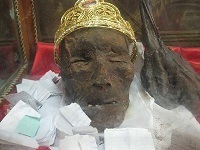
كاهن على طريق القداسة، الخوري
يوسف أبي مارون معتوق من سرعل
- شمال لبنان، 1849 - 1929 |
- Life
of the Father Youssef Abi Maroun
- Infos and Pictures
- Arabic Texts, PDF & Html
file
|
 |
|
|
 |
|
|
|
الخوري "يوسف القديس"..لا يزال "جالساً" على كرسيه
بعد 86 عاما على وفاته! |
|
|
|
|
|
|
|
البطريرك جبرايل
من حجولا الذي
قتله المماليك
حرقا وهو
حي،
البطريرك الشهيد
1357 - 1367، او
الشيخ مسعود |
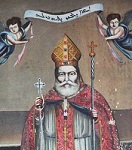
Patriarch Jebrael from Hejoula or Cheikh
Massoud, , 1357 - 1367
- Life of
the Patriarch Jebrael from
Hejoula, 1357 - 1367
- Infos and Pictures
- Arabic Texts, PDF & Html files
|
-
كان راهب ماروني ناسك في قنوبين
-
انتخب بطريرك 1375، نجح في اعادة توحيد
الموارنة واستقلالهم
-
نجاحه
أزعج المماليك،
فقتلوه حرقا بالزيت وهو حي.
-
مدفون قرب جامع طينال في طرابلس، وإلى اليوم
من قبره تخرج الأشفية، قد اتخذه المسلمون لهم مزارا ويسمّونه الشيخ
مسعود.
-
كان رجلا
شهيدا قديسا...
|
|
 |
|
|
|
|
|
|
|
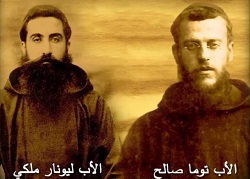
ليونار ملكي
وتوما صالح… قصّة
راهبَيْن
كبّوشيَّيْن |
|
سلّما حياتهما
إلى المسيح
المخلّص واستشهدا
برائحة القداسة
في القرن العشرين |
ولد
الراهبان ليونار عويس ملكي (1881-1915)
وتوما صالح (1879-1917) في بعبدات، وهما
يتحدّران من أسرتين متواضعتين. انتقلا
إلى تركيا لأنهما رغبا في أن يكونا
مرسلَيْن، والتزما في الرهبنة
الكبّوشيّة.
بعد 11 عامًا من إنهاء دراستهما، قصدا
لبنان. من ثمّ، عيّنتهما الرهبنة في
بلاد ما بين النهرين، فعملا في التعليم
مع الشبيبة.
في الحرب العالميّة الأولى التي شهدت
اضطهاد المسيحيّين، أُلقي القبض على
الأب ليونار الذي التزم بعيش رسالته
المقدّسة في ماردين، بعدما حاول إنقاذ
الراهبات، ورفض الرحيل متأثّرًا بأحد
الكهنة الطاعنين في السن الذي خاف من أن
يُترك وحيدًا في مواجهة مضطهدي
المسيحيّين. |
 |
|
بعد إلقاء القبض
عليه، سُجن الأب ليونار، وتعرّض لأقسى
أنواع العذابات: الضرب المبرّح، ونزع
الأظافر، ونتف اللحية… وحاول المضطهدون
آنذاك فرض الدين الإسلامي عليه لكنه واجههم
بالرفض، بل حوّل السجن إلى كاتدرائيّة.
كان الكهنة يمنحون السجناء سرّ الاعتراف (حوالي
800 سجين)، ويحتفلون بالذبيحة الإلهيّة. من
ثمّ، كانوا يُساقون إلى الصحراء، قبل قتلهم.
هذا ما حدث مع الأب ليونار الذي سيق مع
حوالي 417 مسيحيًّا إلى أرض قاحلة حيث نالوا
إكليل الشهادة، بعدما ظلّلتهم غيمة في خلال
قدّاسهم الإلهي، في 11 حزيران 1915.
أما الأب توما صالح، فنُفي من ديار بكر إلى
أورفا حيث استقبله كاهن أرمنيّ وأنقذه من
محاولة قتله، ما جعله مستعدًّا للموت من
أجله.
بعد مرور أشهر عدّة، أُلقي القبض على الأب
توما وعدد من الكهنة في الدير، وتعرّضوا
لأقسى أنواع العذابات، فقضى الراهب الكبّوشي
منفيًّا، بعد إصابته بالتيفوس، في 18 كانون
الثاني 1917. |
|
|
|
|
|
|
|
|
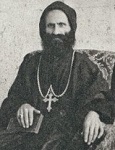
الأباتي اغناطيوس
داغر التنوري،
1957-1877 |
- Life
of the Father Egnatios Tanouris
- Infos and Pictures
- Arabic Texts, PDF & Html files
|
|
|
 |
|
|
|
في لبنان راهب وهو يصلّي كان يمشي في الهواء! |
|
|
|
|
|
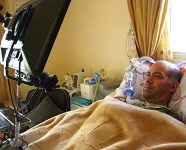
الدكتور جميل زغيب، شهادة حية |
 |
-
الله اختارني، فقبلت يشللي وسلمته امري من
دون خجل.
-
وامنت ان الله يحبني بطريقته الخاصة.
-
وأنا في مهمة مميّزة،
الله وحده عرفها في البدء ومن ثم اختبرتها أنا
فيما بعد.
|
- Life
of the Father EgnatiosTanouris
- Infos and Pictures
- Arabic Texts, Html files
|
|
|
|
|
|
| | | |
|
| | | |
|
|
|
|
| | |
|
|
| www.puresoftwarecode.com
: |
|
HUMANITIES
Institute |
ART Institute
& Others |
| SOFTWARE
Institute |
CHRISTIANITY
Institute |
|
|
| "Free,
100 Software Programming Training Courses"
|
|
History of the MARONITES in
Arabic |
Basilica
Architecture, in the Shape of a Cross |
| VISUAL STUDIO 2010 in
English |
Holy BIBLE in 22 Languages and Studies
... |
Le
HANDICAP c'est quoi ? (in French) |
Old Traditional Lebanese
houses |
| VISUAL STUDIO .NET, Windows & ASP in En |
220 Holy Christian
ICONS |
Drugs and Treatment in English, french,
Arabic |
5 DRAWING Courses & 3 Galleries |
| VISUAL STUDIO 6.0 in
English |
Catholic Syrian MARONITE Church
|
Classification of Wastes from the Source
in Arabic |
Meteora,
Christianity Monasteries, En, Ar, Fr |
| Microsoft ACCESS in
English |
HOLY MASS of Maronite Church - Audio
in Ar |
Christianity in the Arabian Peninsula in
Arabic |
Monasteries of Mount Athos & Pilgrimage |
| PHP & MySQL in
English |
VIRGIN MARY, Mother of JESUS CHRIST
GOD |
Summary of the Lebanese history in
Arabic |
Carved
Rock Churches, in Lalibela, Ethiopia |
| SOFTWARE GAMES in
English |
SAINTS of the Church |
LEBANON EVENTS 1840 & 1860, in
Arabic |
|
| WEB DESIGN in English |
Saint SHARBEL - Sharbelogy in 10 languages |
Great FAMINE in LEBANON 1916, in
Arabic |
my PRODUCTS, and Statistiques ... |
| JAVA SCRIPT in
English |
Catholic RADIO in Arabic, Sawt el
Rab |
Great FAMINE and Germny Role 1916,
in Arabic |
|
| FLASH - ANIMATION in
English |
Saint SHARBEL Family - Evangelization |
Armenian Genocide 1915 in
Arabic |
4 Different
STUDIES |
| PLAY, 5 GAMES |
Читать - БИБЛИЯ и Шарбэль cвятой, in Russe
|
Sayfo or Assyrian Genocide 1915 in
Arabic |
SOLAR Energy & Gas
Studies |
| |
Apparitions
of Virgin Mary - Ar |
Christianity in Turkey in
Arabic |
WELCOME to LEBANON |
| SAADEH BEJJANE
Architecture |
Andree Zouein
Foundation |
|
YAHCHOUCH, my Lebanese
Village |
| CARLOS SLIM
HELU Site, new design |
REPORT, Cyber Attack Attacks the Current
Site |
Prononce English and French and Arabic
Letters |
ZOUEIN, my Family - History &
Trees | |
|
|
|
|